 Intervou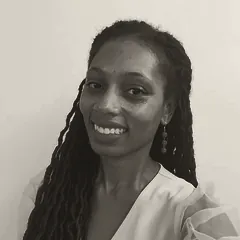
An Intervou with Shanice Harrison
On the Record
The complete interview
A lightly edited transcript of Shanice Harrison's Intervou video interview.
How do you personally balance empathy with decisiveness in leadership?
I'm naturally a very empathetic person, so balancing empathy with decisiveness can be a real challenge. But I just always remind myself of the bottom line in business. Most businesses have to make money. That's a given. Taking that into consideration, it means that sometimes as a leader, you do have to make those tough decisions, and you have to lead with your head instead of your heart, which again can be a challenge.
And sometimes you don't know what the right decision is to make. I find it's best for me to just weigh up my options, try to do it quite quickly, so it's less time-consuming, and just commit to one of them. You're not going to know what's right until you're staying the course of that. It's just believing in it, weighing it up, thinking about, "Okay, how does this impact people?" But also, "How does it impact the business? Is this the right decision for the business?"
If I have two viable options, and one is better for the business, one is better for the people, I would generally go with the people. I'm the sort of person that's always thinking, "How can I make something better for someone else?" But if the business fails, everyone ends up unhappy. So, weighing everything up, you do have to really put the business first sometimes.
How do you approach balancing short-term results with long-term goals?
I'm really trying hard right now to focus on longer-term planning, because in the past, I have very much been focused on short-term goals, and getting those short-term results, because I like that instant gratification. Or even if it's not instant, just knowing that it's coming quite soon as opposed to waiting for potentially years. But that phrase, "Good things come to those who wait," is very true. It's a cliché, but it's true. I think sometimes it is important to know that something big is going to happen for you if you keep pushing forward.
Having those short-term results, like milestones, working towards a bigger goal, that is something that is going to be really good for me right now. It motivates me. And if I ever feel stagnant at a specific point in time, then those short-term results that I get from a milestone are going to remotivate me. They're going to make me feel like, "Yes, I've achieved something and I am moving in the right direction, whether it's slow."
And to be honest, even if I go backwards, it's only temporary. When it comes to progress, it's all over the place. It's never a straight line. So I just need to keep my head up, use smart goals. The GROW coaching technique is amazing. Using those to keep myself on track and really focus on long-term goals as opposed to just short-term results.
Where do you think the sector will be in five years time?
I work in the education sector, and this could be naivety talking, but I don't think things are going to change too much. I think, of course, we already see the differences across the schools, because you'll have some who use technology loads, and they'll almost rely on it, which is not a bad thing, because as a facilitator, I use technology. So let's hope that they continue to use it. But then, of course, we have the other schools that encourage students to read and to write and to, I guess, not use so much technology. And I think we're going to continue to see that, and those differences are really important in the education industry. It gives us that variety.
But we do need to bear in mind that a lot of young people are learning to type and text before they write. So that has to be taken into consideration. They are very familiar with technology. They like social media, some of them. AI as well can be very helpful, and for teachers as well. I mean, AI, ChatGPT has changed the game. Of course there's the flip side of that. Some students using ChatGPT to do their homework, for example. That's not so good.
But I just think nothing's for certain. But I think I can say with my chest that I can't imagine AI taking over teaching staff or replacing teachers, I should say, in the next five years. I think they have a lot of knowledge but they don't have the compassion. So yeah, teaching staff all the way.
What would you tell your younger self starting out in this profession?
The biggest thing is not to focus on the short term because, like I said previously, I have been very focused on short-term goals instead of long-term. So I would tell myself to really put in that, or change that mindset. Think about, what do I want to achieve in five years? Maybe even three years, because five years does seem very far away at times. But just trying to stay on that course and giving myself those short-term goals as motivation milestones, but having that long-term goal is really important, and one that I definitely didn't have when I started teaching and moving into becoming a freelancer as well.
Other things: network more. Of course it can be super scary talking to people. I come from a business background, so networking, I guess, is something that you would expect me to be great at. But there can be a lot of anxiety there. The antisocial part of me wants to run and hide in a corner.
But networking is so, so important. So that is something that I advocate for everyone to do. And it doesn't have to be a networking event. It can be something a lot more casual. And then I think the big cliché of just telling my younger self that I've got this. You've got this. Stay confident, keep your head up. Any setbacks are not forever. Just keep pushing forward. I've always been resilient. But I think sometimes you do just need someone to tell you, keep doing what you're doing.
What personal or professional legacy do you hope to leave behind?
This is something that I ask myself all the time. I use this as a gauge of what my next step is. And really, in truth, the answer is I still don't know.
I think that's okay, because I used to really beat myself up not knowing what was my next step, or what is that long-term goal. I'm still working towards it. But thinking about this, all I do know is that I need to do something bigger than myself, bigger than what I've already done, in order to satisfy this need in me. I really want to believe I want to leave behind something that matters, something that really makes a difference to people. Something that I can be really proud of. Once it hits me, then you'll see it.
But right now, just know that my aim is to do something that matters, something that truly helps people.
More Interviews